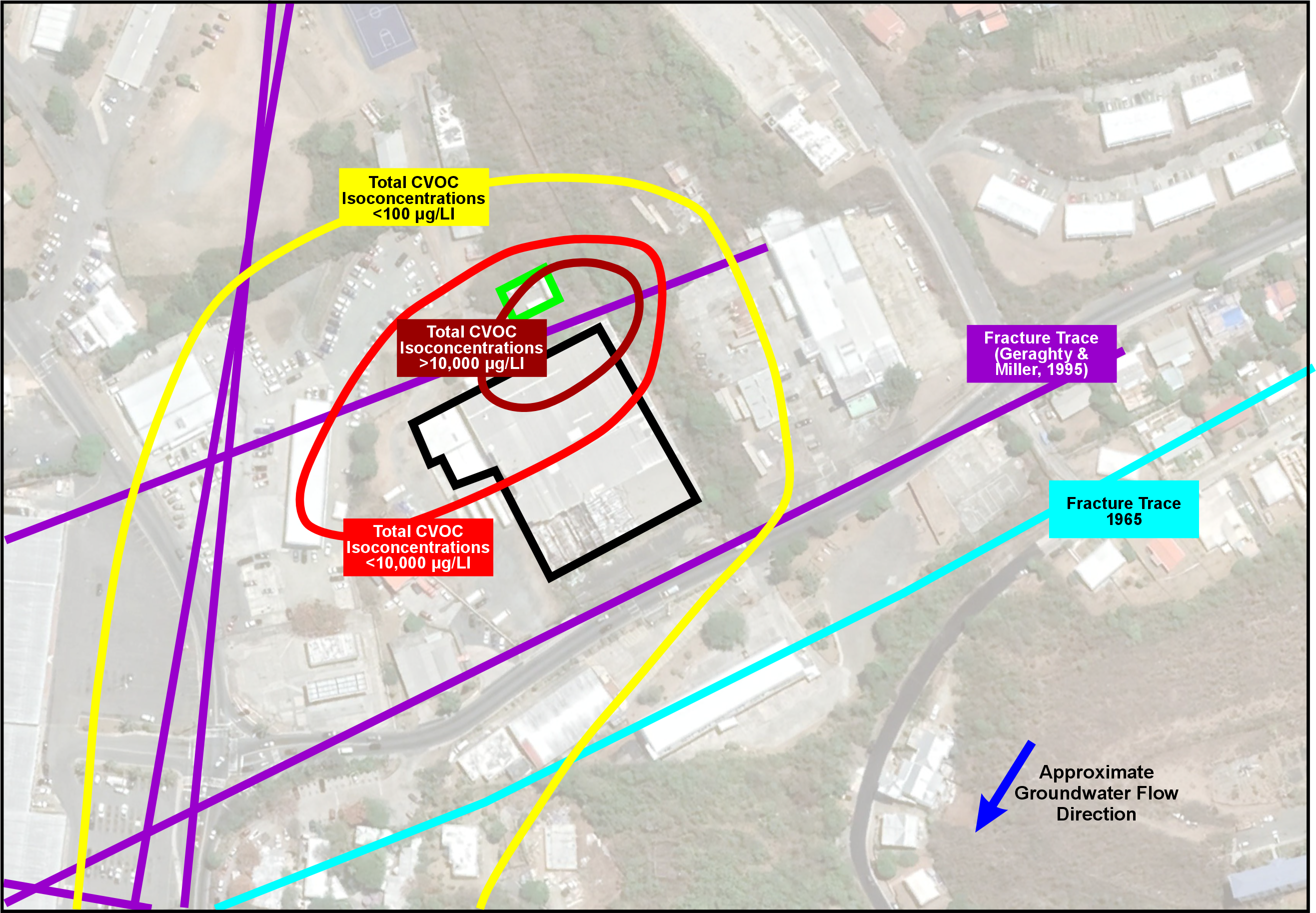
Operable Unit 2 (Site) of the Tutu Wellfield Superfund Site in St. Thomas, U.S. Virgin Islands (USVI) had a groundwater plume impacted with chlorinated volatile organic compound (CVOC) concentrations greater than 200 mg/L in some locations that threatened nearby municipal water supply wells. HDR, one of the leading engineering firms in the world, was tasked with cost-effectively designing remediation to meet environmental clean-up standards and protect the community from harm.
The problem:
Remediation of chlorinated volatile organic compound (CVOC) sites is challenging, particularly in complex geology involving fractured and faulted volcanic bedrock. Fractures and faults provide flowpaths for dense non-aqueous phase liquid (DNAPL) and related dissolved-phase contaminants to migrate vertically and laterally in groundwater. Locating and characterizing flowpaths is critical to remedial design since the bulk of contaminated groundwater is likely to be found in these hydraulically active areas. Successful remedial design/remedial action requires robust remedial design characterization to develop a data-rich and accurate CSM, which is not possible using untargeted drilling data alone.
Approach:
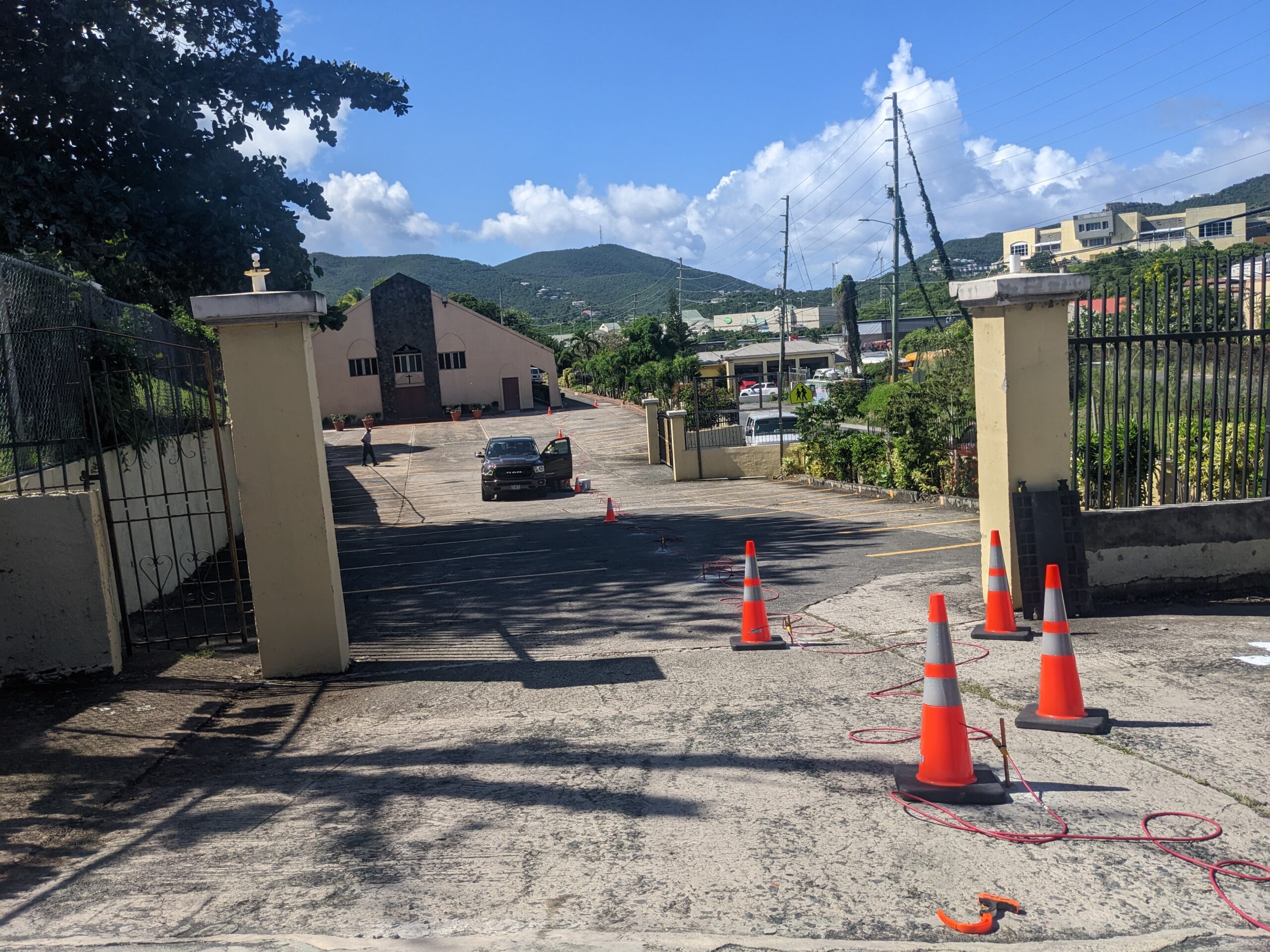
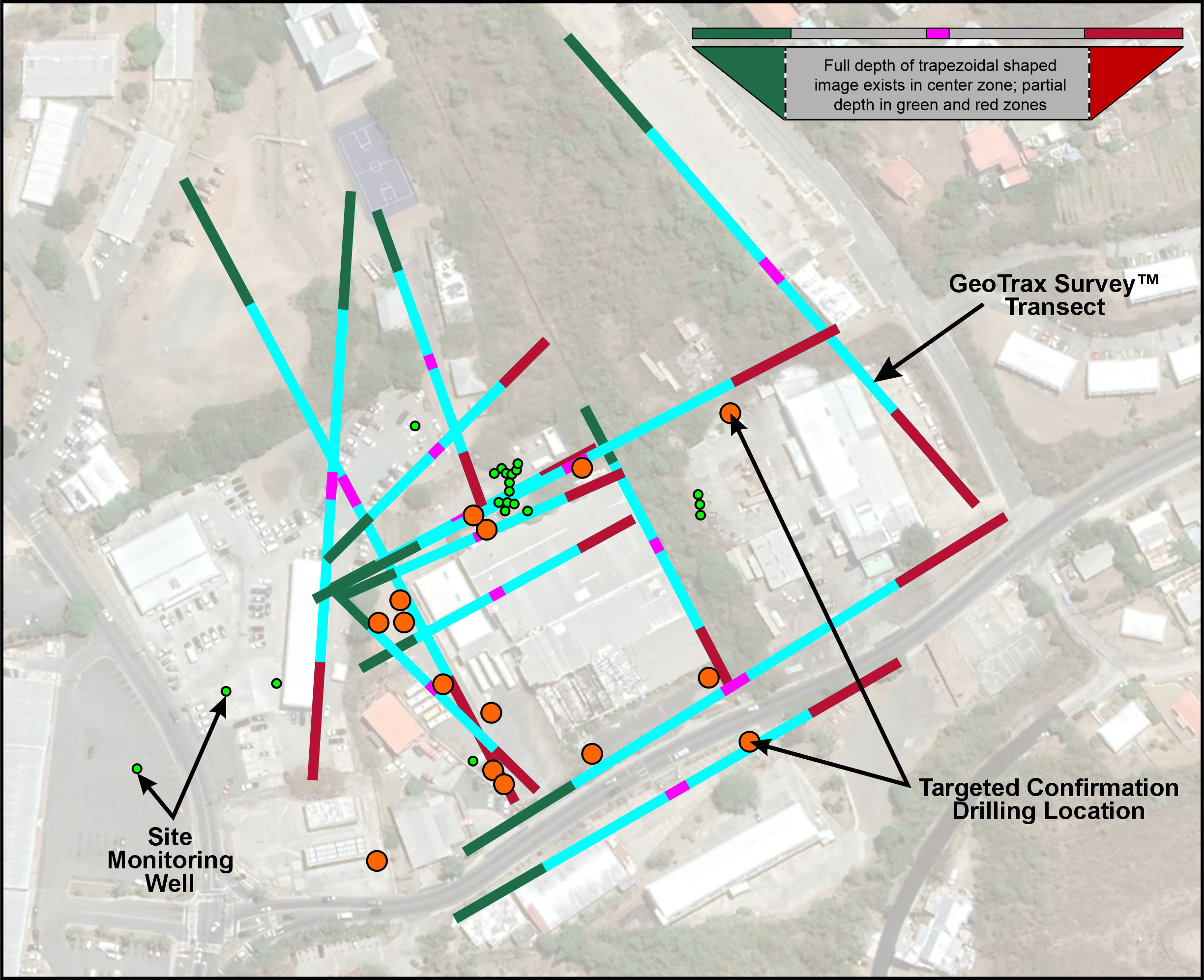
HDR deployed Aestus’ electrical hydrogeology scanning technology and 5-step CSM update process to locate DNAPL and aqueous phase CVOCs in groundwater and identify high-flux flowpaths. Aestus collected continuous 2D electrical images and integrated historical site data (i.e., geology, groundwater concentrations, etc.) into 2D figures and a 3D visualization model (Rockworks). Aestus and HDR worked collaboratively to leverage these integrated data sets and select targeted confirmation drilling locations to target electrical anomalies and understand how these related to faults, fractures, and preferential flowpaths, as well as CVOC-related contaminant distribution.
Outcome:
Aestus was able to assist HDR with developing a data-rich CSM for the site that allowed HDR to focus remedial design/remedial action on high-flux subsurface pathways for more technical and cost-effective remediation. To further assist with remedial design, Aestus suggested additional drilling locations for HDR’s consideration as potential extraction and injection wells based on the updated CSM and electrical imagery.
HDR completed remedial design within three months of Aestus’ final report submission to keep the project moving forward quickly and in a very focused manner. HDR submitted the remedial design document in December 2023, and “Final Remediation Action” is expected to start during the winter 2025 (EPA).
The evolution of this project demonstrated that the use of untargeted vertical borings and monitoring wells was not sufficient to locate and evaluate discrete faults and high-flux flowpaths. Aestus’ imaging technology and CSM update process allowed HDR and the EPA to save time and resources allocated to cleanup of Site by increasing certainty of the CSM and subsequent remedial design.
Specific CSM updates of significance included the following data and conclusions:
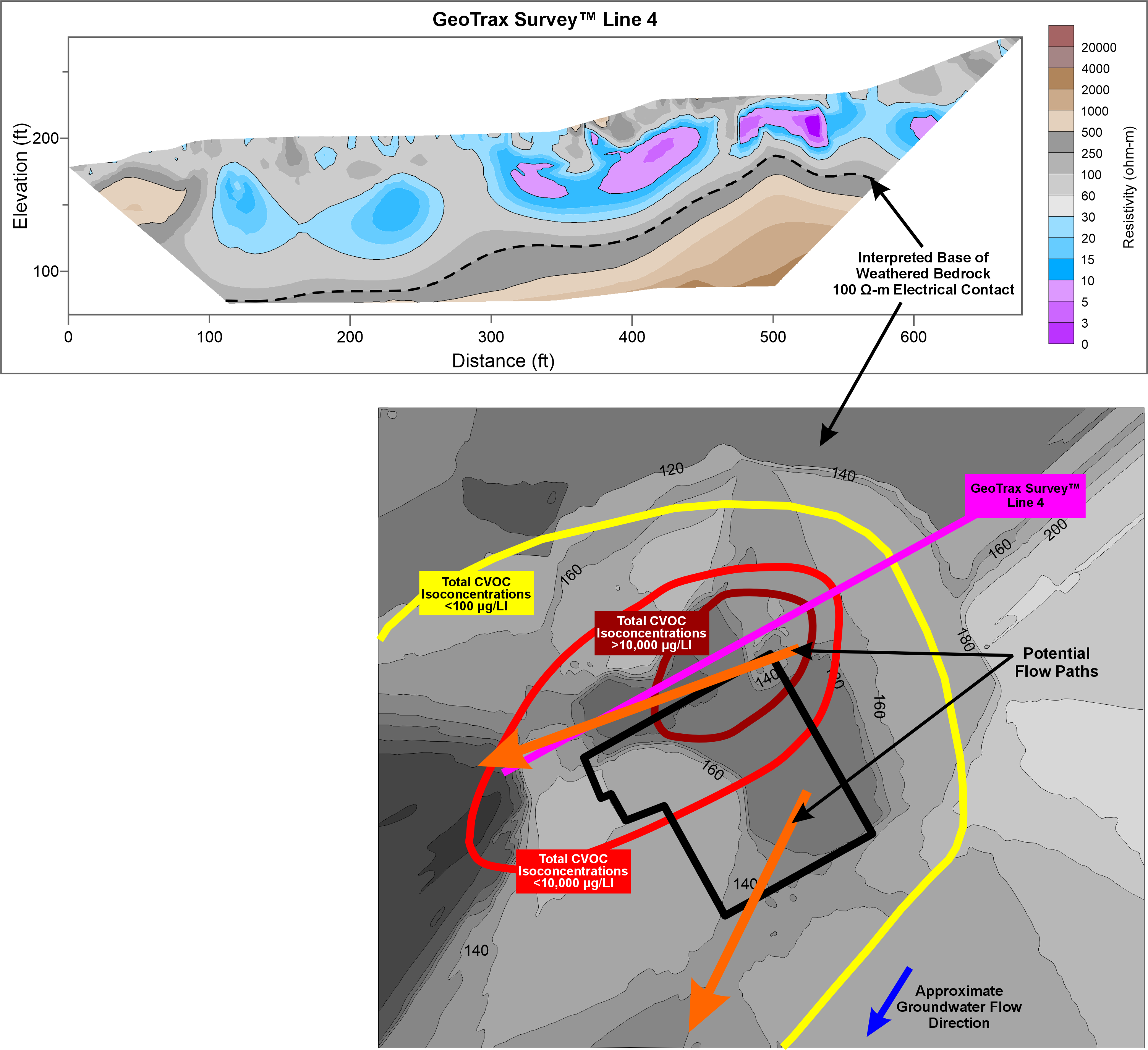
Confirmation drilling targeting GeoTrax Survey image anomalous zone identified location of free-phase DNAPL for the first time in project history; allows focused remediation of source material at this location (see graphic)
Interpreted two, intersecting faults (i.e., Fault A and B) shown in 3D by the pink and purple planes (see graphic)
Targeted drilling confirmed highly fractured zones (red disks in the 3D image) present in rock cores at the intersection of Fault A and B (see graphic)
Step tests in monitoring wells proximal to the intersection of faults mapped by Aestus had a high specific capacity/yield rendering them as optimal remediation well targeted locations
Mapped top of competent bedrock surface (dark gray to light gray surface in the graphic)
Identified potential flowpaths along depressions in the top of weathered andesite (orange arrows in the graphic)
Results
Located two, intersecting faults (confirmed via targeted drilling to be a high-permeability zone)
Identified location of free-phase DNAPL for the first time in site history based on image guided drilling targets
Mapped top of competent bedrock surface (contaminant flowpaths guided by bedrock)
HDR’s collaboration with Aestus resulted in an updated CSM, which provided drilling and remediation system targets in high-flux zones and increased HDR’s confidence in its remedial design for the site.
See below. Succeed above.
Our client needed more certainty in their subsurface data. We integrated existing site data, our GeoTrax Survey™ electrical images, and targeted confirmation drilling data to yield a more complete understanding of the subsurface. This allowed them to:
Make better technical/business decisions
Have clear roadmap for next steps
Achieve project goals faster and cheaper
Client Testimonial
Aestus has been great to work with and we are very pleased with their value added to our project. Their GeoTrax CSM+™ process helped us improve the conceptual site model (CSM) at the Tutu Wellfield Superfund Site in St. Thomas, U.S. Virgin Islands and allowed the project team to make better technical and budgetary decisions for the project. Specifically, Aestus’ integral GeoTrax Survey™ subsurface imaging process located fractures, faults, and a deformation zone where most of the groundwater flow and contaminant migration is occurring.
Without this improved CSM understanding, we would not have been able to target our remedial design investigation by focusing monitoring and planned extraction wells in the high flow pathways so that our chlorinated solvent remediation can be more technically and cost effective. We would highly recommend Aestus for projects where the stakeholders want to enhance their site understanding to make more informed and effective decisions on characterization and remediation, with the goal of reaching site closure more quickly and cost effectively.
Demetrios Klerides, P.E., BCEE - Senior Project Manager / Professional Associate at HDR, Inc
Guesswork is the enemy of smart drilling. It leads to wasted money, rework, and nonstop frustration. Aestus scans your site and interprets the data so you can see what’s beneath the surface, make smart decisions, and keep your project moving forward.
Since joining Aestus in 2024, Madison has performed various project tasks including field data acquisition, data integration and analysis, 2D and 3D visualization, and project report development.
As an undergraduate at Oklahoma Sate University, Madison utilized electrical resistivity imaging to locate a drilling target for a municipal water well in rural Oklahoma. Her Master’s degree, also from Oklahoma State University, focused on the production and laboratory testing of a novel groundwater tracing particle for use in a sole source aquifer.
Madison previously worked at an environmental consulting firm in Dallas, Texas, where she performed soil/groundwater investigations/reporting, PFAS sampling programs, and Environmental Site Assessments.
Madison is based out of Irving, Texas.
Michelle Lahti, PACE
Administrative Director
Since joining Aestus in 2021, Michelle has supported the CEO and other managers in their day-to-day needs. She also manages human resources and all elements of the many conferences Aestus attends. Michelle works hard to ensure that the needs of stakeholders are addressed in all steps of the business process when working with our clients. Michelle has a bachelor’s degree in Avionics Engineering Technology from Embry-Riddle Aeronautical University. She also has experience as a small business owner, and over 15 years’ experience as an executive assistant in many different industries. She has her Professional Administrative Certification of Excellence (PACE) through the American Society of Administrative Professionals (ASAP). Michelle is based out of Wellington, Colorado.
Autumn M. Town, M.Sc.
Staff Geologist / Field Technician
Autumn performs various project tasks for Aestus, including field data acquisition, data integration and analysis, 2D and 3D visualization, and project report development. Since joining Aestus in 2023, she has helped meet project objectives such as mapping stratigraphy, identifying areas of contamination, and characterizing preferential flow pathways at complex sites across the United States. As an undergraduate at Oklahoma State University, Autumn utilized electrical resistivity imaging (ERI) to evaluate the hydrogeologic effects of PFAS-containing firefighting foams. While completing her Master’s degree, also at Oklahoma State University, she focused primarily on sedimentology and stratigraphy as she studied the effects of depositional and diagenetic processes on porosity development in a tight gas sandstone reservoir.
Autumn is based out of Tulsa, Oklahoma.
Morgan Love, M.Sc.
Senior Project Geologist
Morgan has been a part of the Aestus team since 2012. She supports all aspects of data integration for Aestus in 2D and 3D space, including modeling of geophysical, geochemical, and geologic data. She also performs geophysical data processing and develops quality control and automation protocols to ensure data integrity.
Prior to Aestus, Morgan used her environmental geology undergraduate degree working for a water resource company, a geosciences software company, and a seismic data acquisition company. She holds a Master's Degree in Computer Information Systems.
Morgan is based out of Fort Collins, Colorado.
Grant Eastman
Equipment Manager / Field Technician
Grant maintains all our equipment and vehicles at a firehouse ready status in order for the field team to be ready to mobilize at moment’s notice. He also troubleshoots any technical issues that come up as well as being a member of the field team.
Grant graduated from Colorado State University with a degree in Watershed Science. After graduating he completed 8 years of military service with the Colorado Army National Guard, including two deployments to the middle east. Before joining Aestus, he was a senior technician building custom automation equipment and wire harness mockups for aerospace companies.
Grant is based out of Milliken, Colorado.
Samantha Frandsen, M.Sc, P.Gp.
Hydrogeophysicist / Project Manager
Since joining Aestus in 2018, Samantha has performed all aspects of the Aestus project lifecycle, including acquisition field work, processing of geophysical data, data integration, 3D visualization, and reporting. As project manager, she oversees a variety of projects completed at complex sites across the United States and strives to help our clients efficiently leverage Aestus’ high-resolution GeoTrax Survey™ data to improve understanding of subsurface conditions.
Prior to her time with Aestus, she earned her Bachelor’s degree (magna cum laude) in Physics from the University of Richmond and taught high school physics as a Teach for America corps member. She then completed her Master’s degree (Distinction) in Exploration Geophysics at the University of Leeds in the UK. For her thesis, she utilized several different geophysical techniques to characterize the subsurface remains of a former gasworks facility for which she was awarded the GETECH award for best overall performance in the Independent Project and the Association for Industrial Archaeology’s Dissertation Award.
When she’s not investigating what’s below the ground, Samantha enjoys exploring all the above-ground fun her Stateline (South Lake Tahoe), NV home has to offer via trail running, mountain biking, and snowboarding.
Samantha is based out of Stateline, Nevada.
Michael McNair
Project Geologist / Field Team Leader
Michael has worked on a variety of project types using Aestus’ electrical hydrogeology techniques to help Aestus’ clients succeed relative to characterization of contaminated sites, evaluating geohazards, municipal water well exploration, and monitoring subsurface changes over time. Michael currently manages Aestus’ field operations to collect high quality subsurface electrical imagery (GeoTrax Survey™) at rural, urban, and industrial sites with complex logistics. When not in the field, Michael is a key member of Aestus’ reporting team and leads or assists with 2D/3D data integration, QC, data interpretation, and reporting.
Michael previously worked at an environmental consulting firm in Dallas, Texas, where he performed soil/groundwater investigations in the field and subsequently developed reports. Michael earned a Bachelor of Science in Geology from Baylor University.
Michael is based out of Orlando, Florida.
Todd Halihan, Ph.D., P.Gp.
CTO/Data Interpretation Lead
Todd’s focus at Aestus centers on subsurface characterization using electrical hydrogeology and sustainable water supply. He is also a professor and the Sun Company Clyde Wheeler Chair in Hydrogeology at Oklahoma State University. He was the National Ground Water Association’s 2018 McEllhiney Lecturer and he is a founding member of the NGWAU program for groundwater outreach and education.
Dr. Halihan is the recipient of the American Institute of Hydrology’s C.V. Theis Award winner. He is also a professional geophysicist (CA), professional driller (OK) and a PADI divemaster.
Todd is based out of Stillwater, Oklahoma.
Stuart W. McDonald, P.E.
CEO/Project Executive/Contracting
Stuart has dedicated over 20 years of his career overseeing the development of Aestus with the goal of empowering clients worldwide to gain more certainty in subsurface issues to make better technical decisions and save time and money on their projects. He has been involved in managing hundreds of projects for Aestus in the USA, Europe, Asia, and South America.
Stuart spent the first decade of his career as an environmental consultant primarily with Canonie Environmental and Harding Lawson Associates and gained experience performing cradle to grave site characterization and remediation work on high profile Superfund and other projects. This experience was the genesis of founding Aestus in 2001 as it became clear that the environmental industry needed more data density and more certainty for optimal decision-making on projects.